Selecting a reliable partner for high-volume cookware production requires more than just comparing price lists; it necessitates an understanding of the metallurgical integrity and casting precision involved in heavy-duty kitchenware. For commercial distributors and retail brands, the ability to scale production without compromising the thermal distribution of a skillet or the seal of a Dutch oven is the primary differentiator.
The shift toward enamel coatings and specialized camping gear has pushed the boundaries of traditional foundries, demanding a blend of heritage craftsmanship and modern chemical engineering. Today's market requires cookware that is not only durable but also compliant with global safety standards and adaptable to various heating sources.
Whether you are developing a private label line or upgrading industrial specifications, understanding the operational capabilities of a cast company pots and pans specialist is essential for ensuring product longevity and brand reputation.


The transition from traditional sand casting to advanced foundry management has allowed manufacturers to reduce porosity and improve the structural consistency of cookware. Modern facilities now integrate shot blasting and pre-seasoning stages to eliminate surface imperfections that previously led to uneven seasoning or enamel peeling.
Zhongdacook, established in 1993, exemplifies this trajectory by merging traditional robustness with scientific management systems. By focusing on a development-oriented approach, the integration of R&D ensures that the transition from raw material to a finished Sizzler Plate or Wok maintains strict dimensional tolerances.
The primary value of cast iron lies in its thermal inertia. Unlike thin-walled aluminum or stainless steel, cast iron absorbs and retains heat with high efficiency, making it indispensable for searing and slow-braising. The engineering challenge for any cast company pots and pans producer is to balance wall thickness with weight to ensure the vessel is manageable without creating "hot spots."
Achieving this balance requires precise control over the cooling rate during the casting process. If the iron cools too quickly or unevenly, internal stresses can develop, potentially leading to cracks under high thermal shock. This is why advanced production equipment and superb technology are critical for producing high-end Dutch Ovens and Grill Griddles.
Furthermore, the chemical composition of the iron must be strictly monitored. The ratio of carbon and silicon determines the fluidity of the molten metal and the final hardness of the product, which directly impacts the ease of seasoning and the longevity of the cookware's non-stick properties.
Enameling transforms the porous nature of cast iron into a non-reactive, glass-like surface. This process not only eliminates the need for traditional seasoning but also allows for a wider range of acidic ingredients to be cooked without altering the flavor of the food. The use of high-grade materials, such as TOMATEC enamel, ensures a durable bond between the iron substrate and the coating.
The integrity of enamel cookware depends on the synergy between the surface preparation—such as shot blasting—and the precision of the firing temperature, as any microscopic impurity can lead to chipping or bubbling in the final product.
Customization in enameling extends beyond color. The ability to laser engrave logos on stainless steel lid beads or the enamel surface allows brands to maintain a high-end identity without requiring excessive minimum order quantities for basic branding. This flexibility is crucial for companies testing new market segments with boutique cookware sets.
For B2B buyers, the timeline from conceptual design to batch delivery is a critical risk factor. The creation of customized molds is the most time-intensive phase, typically requiring 7 to 10 days for mold making and an additional 3 to 10 days for sample approval. Once the design is locked, the batch order lead time is generally around 30 days.
Efficient logistics also encompass the packaging strategy. To ensure these heavy items survive international transit, a tiered approach—plastic bagging, color or brown inner boxes, and reinforced master cartons—is standard. This minimizes the risk of chipping for enameled products and ensures the product arrives in retail-ready condition.
Cast iron's versatility extends far beyond the domestic kitchen. In professional gastronomy, Sizzler Plates and Fajita pans are utilized to maintain high temperatures from the kitchen to the table, enhancing the sensory experience of the meal. The high heat capacity ensures that proteins continue to sear even after being served, a requirement that only heavy-duty cast iron can satisfy.
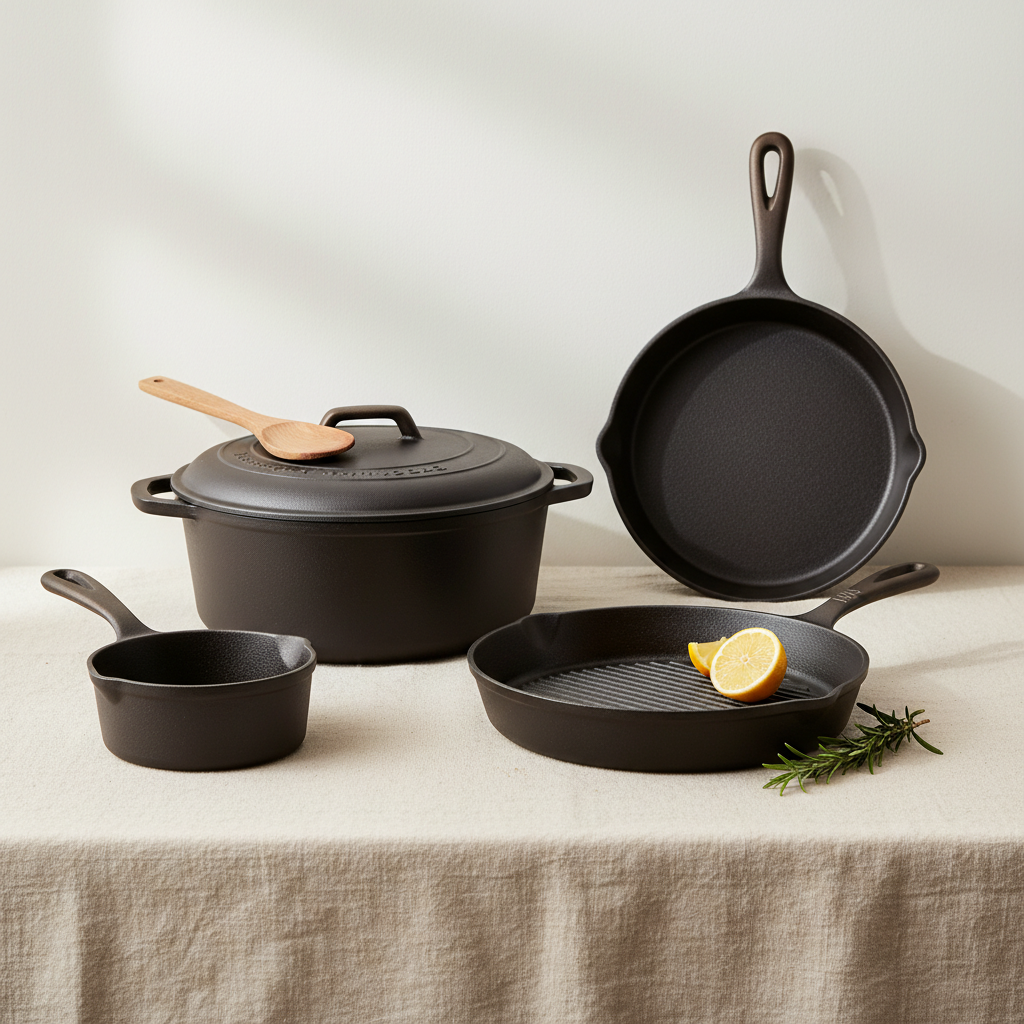
Simultaneously, the rise of luxury camping (glamping) has increased demand for specialized Cast Iron Camping Cookware. These products must be engineered for extreme durability and versatility, capable of withstanding open flames and charcoal heat. The ability of a manufacturer to provide a cohesive Cast Iron Cookware Set—including saucepans and griddles—allows outdoor brands to offer a comprehensive culinary solution to their customers.
The industry is currently moving toward a more sustainable manufacturing model. This involves the implementation of eco-friendly practices within the foundry, focusing on the reduction of emissions during the melting process and the recycling of casting sands. As environmental regulations tighten globally, the ability to produce "green" cast iron becomes a competitive advantage.
Another emerging trend is the hybridization of materials. We are seeing a greater integration of stainless steel components in lids and handles to improve ergonomics and hygiene, while maintaining the cast iron core for heat retention. This shift reflects a deeper understanding of user behavior, where professional chefs seek the performance of iron with the ease of maintenance found in modern alloys.
Ultimately, the goal is to create "lifetime products." The focus is shifting from disposable, short-term cookware to heritage pieces that can be passed down through generations. This requires a commitment to quality control and a willingness to provide lifelong support for the products, ensuring that the bond between the brand and the consumer is as durable as the iron itself.
When evaluating a potential manufacturing partner, buyers should use a structured framework that prioritizes technical capability over initial cost. The cost of a customized mold—ranging from USD 800 to USD 1600 per piece—is a necessary investment in precision. A lower mold cost often signals a lack of durability in the tooling, which can lead to inconsistent product dimensions in later batches.
The Minimum Order Quantity (MOQ) is another critical lever. A standard MOQ of 500 pieces per size and color is common for individual items, while casted logos typically require 1000 pieces for the initial run. Understanding these thresholds allows procurement managers to plan their inventory cycles and budget for ODM/OEM services effectively.
Finally, the guarantee and support system must be verified. While electrical goods have standard one-year warranties, high-quality cast iron is fundamentally a lifetime product. A manufacturer's willingness to provide samples and offer post-purchase technical support is a strong indicator of their confidence in the product's metallurgical quality.
| Evaluation Factor | Standard Requirement | Impact on Quality | Selection Consideration |
|---|---|---|---|
| Mold Precision | USD 800 - 1600 /pc | Dimensional Accuracy | Prioritize tool longevity |
| Enamel Grade | Industrial Brand (e.g. TOMATEC) | Surface Durability | Check for peeling resistance |
| MOQ Threshold | 500 - 1000 pcs | Production Scalability | Align with market demand |
| Lead Time | 30 days (Batch) | Supply Chain Stability | Buffer for shipping logistics |
| Surface Treatment | Shot Blasting/Pre-seasoning | Seasoning Adhesion | Essential for non-enamel |
| Branding Method | Laser / Casted Logo | Brand Identity | Balance MOQ vs Aesthetics |
A professional foundry, such as Zhongdacook, owns the entire production chain, from raw material melting and mold creation to shot blasting and enameling. This allows for direct control over quality, faster customization (OEM/ODM), and more competitive pricing by eliminating intermediaries. Trading companies typically lack the ability to modify mold designs or provide detailed technical guarantees on the metallurgy of the pots and pans.
Quality evaluation should focus on surface uniformity, adhesion, and the brand of enamel used (e.g., TOMATEC). A high-quality coating should be free of pinholes, bubbles, or "orange peel" textures. In terms of performance, it should resist chipping under thermal stress and be chemically inert when exposed to acidic foods. Requesting samples to perform a thermal shock test is the most reliable way to verify the bond between the enamel and the iron.
The development cycle generally consists of three phases: Mold Making (7-10 days), Sample Production and Approval (3-10 days), and Batch Order Production (approximately 30 days). The total time from the initial design to shipment usually ranges between 40 to 50 days, depending on the complexity of the design and the speed of sample approval. Planning for these durations is essential for maintaining seasonal retail launches.
Yes, branding options vary by method. Laser engraving on stainless steel lid beads or the enamel surface often has no minimum quantity requirement, making it ideal for small batches. However, for a logo to be physically cast into the iron body of the cookware, a higher volume is required—typically 1000 pieces for the first batch and 500 pieces for subsequent orders—due to the cost and effort of modifying the physical molds.
While the material is the same, the design intent differs. Kitchen cookware often focuses on aesthetics, precise lid fits, and enamel finishes for indoor use. Camping cookware is designed for ruggedness, often featuring handles that double as lids or integrated locking mechanisms. Camping gear is typically pre-seasoned to provide a natural non-stick surface that can be maintained over an open fire, whereas kitchen gear may be enameled for easier cleaning.
When manufactured correctly with high-purity iron and proper surface treatment, cast iron is virtually indestructible. Unlike Teflon-coated pans that degrade over time, cast iron can be re-seasoned indefinitely. Even enameled cast iron, if handled with care, can last for decades. The "lifetime" aspect refers to the material's ability to withstand extreme heat and wear, provided the user follows basic maintenance protocols to prevent rust.
The procurement of high-quality cast iron cookware is a strategic decision that balances metallurgical science with commercial viability. By focusing on the technical foundations—from the precision of the foundry to the chemistry of the enamel—brands can ensure they deliver products that meet the rigorous demands of both professional chefs and outdoor enthusiasts.
As the industry evolves toward greater sustainability and material hybridization, the partnership between a brand and its manufacturer becomes the cornerstone of success. Investing in a partner who provides a transparent development process, reliable lead times, and a commitment to lifetime quality is the only way to thrive in the competitive global cookware market.